
TL;DR
Small nail holes take 15 minutes and $10 in supplies. Holes under 4 inches need a patch kit and two coats of compound done in a day. Holes bigger than 6 inches need backing, tape, and texture matching that’s where most DIY jobs fall apart. If your hole is near plumbing, on the ceiling, or has water damage around it, skip the hardware store and call a pro. Here’s the full breakdown by hole size so you know exactly what you’re dealing with.
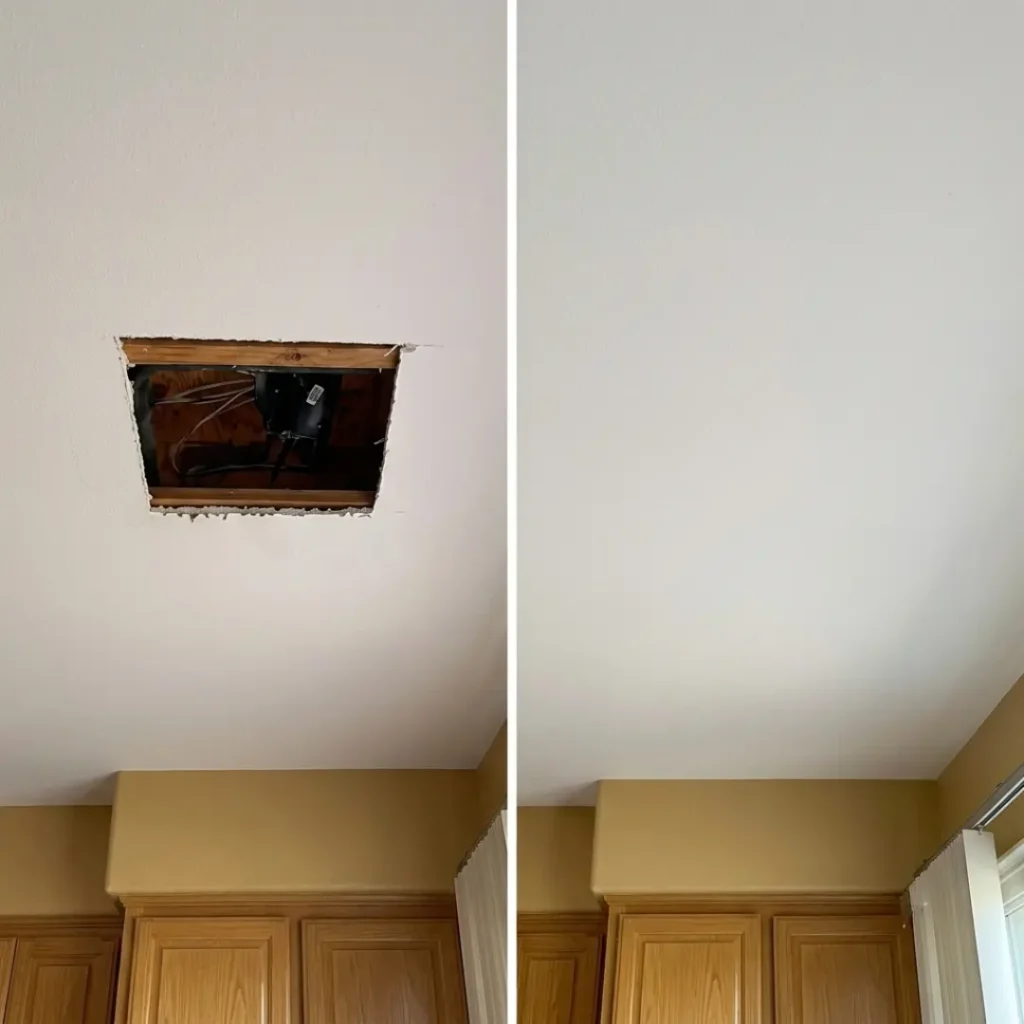
A hole in your drywall isn’t the end of the world. Doorknob punched through the wall, anchor ripped out, kid threw something it happens in every home. The real question is: can you fix it yourself, or are you going to make it worse?
Here’s the honest answer. Small holes? You can handle it. Anything bigger than your fist, anything on the ceiling, anything near water damage call a professional. A $150 pro repair beats a $400 “I tried to fix it myself” situation every single time.
This guide breaks it down by hole size so you know exactly what you’re dealing with before you touch anything.Key Highlights — How to Fix a Drywall Hole
Key Highlights — How to Fix a Drywall Hole
Nail Holes & Tiny Dents (Under 1 inch)
Spackle, finger, done. Costs $5–$10 in materials. 15 minutes of work. No skill required.
Small Holes (1–4 inches)
Use a self-adhesive patch kit. Two coats of compound, light sanding, prime and paint. Total time: one day (mostly drying). Cost: $15–$30 in supplies.
Medium to Large Holes (4–12 inches)
Needs backing, a drywall patch, tape, and 2–3 coats of joint compound. Texture matching is where most people give up. If the wall has any texture, a pro finish is almost always better.
Ceiling Holes or Water Damage
Stop. Don’t DIY this. Ceiling drywall is physically harder, and water damage means there’s likely a moisture source that needs fixing first. Call a professional before you close up the wall.
Fixing Drywall Holes by Size — Step by Step
Nail Holes & Tiny Dents (Under 1 Inch)
This is the easiest repair in home maintenance. You need lightweight spackle, a putty knife, fine sandpaper, and matching paint. That’s it.
- Dab spackle into the hole with your finger or a putty knife
- Smooth it flat — slightly overfill, it shrinks as it dries
- Let dry completely (30–60 minutes)
- Sand lightly with 120-grit sandpaper
- Prime and touch-up paint
Total cost: $5–$15 in supplies. Total time: under an hour including drying.
Pro Tip: If you have 10–15 nail holes in a room, do them all in one pass — fill, dry, sand, paint in one session. Much more efficient than going hole by hole on different days.
Small Holes: 1–4 Inches (Self-Adhesive Patch Method)
This is your doorknob dent, anchor pull-out, or cabinet screw that got yanked. A hardware store patch kit handles these fine.
What you need:
- Self-adhesive drywall patch (sold at any hardware store, $8–$15)
- All-purpose joint compound (pre-mixed, $12–$18 for a small tub)
- Putty knife or 6-inch drywall knife
- 120-grit and 220-grit sandpaper
- Primer + matching paint
- Clean the edges of the hole remove any loose drywall paper or crumbling edges
- Stick the self-adhesive patch centered over the hole
- Apply first coat of joint compound over the patch with your putty knife. Feather the edges out 3–4 inches past the patch
- Let dry completely — at least 4–6 hours, overnight is better
- Sand smooth with 120-grit, then apply second thin coat
- Let dry again, sand with 220-grit until perfectly smooth
- Prime and paint
Total cost: $20–$40. Total time: one full day (mostly drying). Main risk: rushing the drying. Wet compound under paint bubbles and cracks.
Medium Holes: 4–6 Inches (California Patch Method)
Self-adhesive patches start to fail above 4 inches — they’re not rigid enough. You need the California patch, which uses a piece of drywall as its own backing.
What you need:
- A scrap piece of drywall slightly bigger than the hole
- Drywall knife or jab saw
- Joint compound
- Paper drywall tape
- Drywall screws (if using backing boards)
- Cut a square or rectangle around the damaged area — clean straight edges only
- Cut a patch piece slightly larger than the hole from scrap drywall
- Score the back of the patch so you can snap off the drywall core, leaving a paper “flap” on the front face — this flap becomes your built-in tape
- Test fit the patch into the hole
- Apply joint compound around the hole edges, press the patch in, and smooth the paper flaps down into the compound
- Feather compound outward 4–6 inches. Let dry
- Second coat, sand, third coat if needed, sand again
- Prime and paint
Pro Tip: The California patch only works cleanly if your cuts are straight. A jab saw is worth the $10 — a jagged hole edge makes everything harder. Take an extra 2 minutes and cut it clean.
Large Holes: 6+ Inches (Backing Board Method)
This is where most DIY jobs fall apart. Holes above 6 inches need real structural backing wooden boards secured inside the wall cavity so your patch doesn’t flex and crack later.
What you need:
- 1×3 or 1×4 wood boards (cut to fit inside the wall cavity)
- Drywall screws
- A piece of drywall cut to match the hole exactly
- Paper tape + joint compound
- Drywall knife, screw gun, sandpaper
- Square up the hole with straight cuts on all sides
- Cut two backing boards long enough to extend 3–4 inches past the top and bottom edges of the hole
- Insert boards into the wall cavity and screw them to the existing drywall — they’ll hold your patch
- Cut your drywall patch to fit exactly, screw it into the backing boards
- Tape all seams with paper drywall tape and joint compound
- Three coats of compound with full drying between each
- Sand, prime, paint — and texture match if needed
Total time: 2–3 days minimum. This is also where texture matching becomes a real problem. If your walls have any texture — orange peel, knockdown, skip trowel matching it is genuinely difficult without practice.
If the hole is in a visible area like a living room or hallway, I’d honestly recommend calling a pro for anything over 6 inches. A bad texture match is obvious every time someone walks into the room. We handle drywall hole repair and drywall repair in Forest Park, IL regularly texture matching included.
Tools & Materials You Need (By Repair Size)
| Hole Size | Tools Needed | Estimated Supply Cost |
|---|---|---|
| Under 1 inch | Putty knife, spackle, sandpaper | $5 – $15 |
| 1–4 inches | Patch kit, putty knife, joint compound, sandpaper | $20 – $40 |
| 4–6 inches | Jab saw, drywall scrap, joint compound, paper tape | $30 – $60 |
| 6+ inches | Full kit: saw, wood backing, drywall sheet, screws, compound, tape | $50 – $100+ |
Mistakes That Ruin DIY Drywall Repairs
Most failed repairs come down to the same few mistakes. Here’s what to avoid:
- Not letting compound dry fully. This is the #1 problem. Every coat needs to be completely dry before you sand or apply the next. It turns white when dry — if it looks gray or feels cool, it’s not ready.
- Applying compound too thick. Thin coats, multiple times. A thick coat cracks as it dries.
- Skipping primer before paint. Paint over bare compound absorbs unevenly and shows a dull spot called “flashing” even after it dries.
- Trying to match texture without practice. Orange peel and knockdown textures are sprayed with specific equipment at specific pressures. Without practice, a mismatched texture stands out worse than the original hole.
- Patching over water damage without fixing the source. If the wall got wet, find out why before you close it up. Patching over active moisture is just postponing a bigger problem.
When to Stop and Call a Professional
DIY drywall repair makes sense for small holes in low-traffic areas. But there are situations where calling a pro saves you time, money, and a lot of frustration.
| Situation | Why It Needs a Pro |
|---|---|
| Hole is on the ceiling | Overhead work is physically demanding, compound application fights gravity, and scaffolding may be needed |
| Water staining around the hole | Active or past moisture — source must be found before repair |
| Mold visible inside the wall | Mold remediation required before any drywall work |
| Hole is in a highly visible area | Texture matching without experience almost always shows |
| You already tried and made it worse | A bigger patch is needed now — better to start fresh with a pro |
| Multiple large holes in one room | At that point, partial wall replacement may be more cost-effective |
If you’re in Forest Park, IL or anywhere nearby Chicago, Oak Park, Berwyn, River Forest we can come out, assess the damage, and give you a straight quote.
What a Professional Repair Looks Like vs DIY
| DIY | Professional | |
|---|---|---|
| Tools | Basic hardware store supplies | Commercial-grade knives, sprayers, professional compounds |
| Texture matching | Hit or miss without practice | Matched to existing wall — nearly invisible |
| Time investment | Your weekend, spread over 2–3 days | Usually same-day or next-day completion |
| Cost (small hole) | $10–$40 materials | $89–$150 total |
| Cost (large hole) | $50–$100 materials + your time | $200–$400 total with professional finish |
| Risk | Visible patch, cracking, texture mismatch | Warranty on the work |
The math isn’t always in favor of DIY once you factor in your time, multiple trips to the hardware store, and the real possibility of a visible repair that bugs you every day. For anything above 4 inches in a room you care about, calling a pro is usually the smarter call.
How We Handle Drywall Hole Repair at Near Me Handyman Services
When someone calls us about a drywall hole, here’s exactly what happens:
- We assess the damage — size, cause, whether there’s moisture or mold involved
- We match the drywall type (standard, moisture-resistant, fire-rated) to whatever’s already in your wall
- We install proper backing for any hole over 4 inches
- We apply compound in thin coats — no rushing the dry time
- We texture match before painting — this is where we earn our price
- We prime and paint the repaired area
Most standard drywall hole repairs are done same day. Water damage jobs take longer because we won’t close up a wall until we know the moisture source is handled.
Near Me Handyman Services covers Forest Park and the surrounding area. You can also see all our repair services at Handyman Services Near Me.
Where Does This Information Come From?
Repair methods and timing estimates in this guide are based on standard drywall industry practice. Cost references are drawn from HomeAdvisor and Angi, which aggregate real project costs from contractors across the U.S. Local pricing in the Forest Park and Chicago area tends to run at the mid-to-upper end of national ranges based on labor costs in this market.
Serving Forest Park and Surrounding Areas
We provide Drywall Repair Service in Forest Park, IL and also serve homeowners in Elmhurst, Brookfield, Oak Park, Berwyn, and River Forest. Same-day availability depending on job size and schedule.
Need a Drywall Hole Fixed the Right Way?
Frequently Asked Questions
For holes over 6 inches, you need wood backing boards installed inside the wall cavity first. Then cut a drywall patch to fit, screw it to the backing, tape the seams with paper tape, and apply 2–3 thin coats of joint compound. The whole process takes 2–3 days because of drying time between coats. Texture matching at the end is the hardest part.
Yes, for the vast majority of holes. Even large holes (6–12 inches) can be patched with a cut-in section and backing boards without replacing a full wall. Full sheet replacement only makes sense if there’s extensive water damage or multiple large holes throughout an entire section.
Each coat of joint compound needs at least 4–6 hours to dry, and most repairs need 2–3 coats. Realistically, plan on 24–48 hours from start to paint-ready for anything beyond a nail hole. Rushing dry time is the most common reason repairs crack or bubble later.
Small holes (under 4 inches) typically run $89–$150. Medium holes (4–6 inches) run $150–$250. Large holes (6 inches+) start around $200–$400 depending on location, texture matching, and whether paint is included. Ceiling holes cost more because of the overhead work involved. Call us at (331) 240-9003 for a straight quote on your specific situation.